
From HELOCs to Handshakes: The Best Ways to Finance Your Remodel
Leveraging Home Equity: HELOCs and Refinancing
When we look at the best way to finance home improvement projects, home equity is often the heavyweight champion. If you’ve owned your home for a few years, you’re likely sitting on a significant source of wealth. In Canada, home equity financing is popular because it usually offers the lowest interest rates available, simply because the loan is secured by your property.
A Home Equity Line of Credit (HELOC) is a flexible, revolving credit limit. Think of it like a giant credit card attached to your house, but with much lower interest rates. In Canada, lenders typically allow you to borrow up to 65% of your home’s value through a HELOC. However, the total of your outstanding mortgage and your HELOC cannot exceed 80% of the home’s market value.
For example, if your home is worth $800,000 and you owe $300,000 on your mortgage, your maximum loan-to-value (LTV) at 80% is $640,000. Subtracting your $300,000 mortgage leaves you with a potential HELOC of $340,000.
The beauty of a HELOC is that you only pay interest on what you actually spend. If you have a $50,000 limit but only use $10,000 for a new roof, you only owe interest on that $10,000. This makes it ideal for projects where the final cost is uncertain. For more details on the fundamentals of home improvements, you can explore Fixing Up Your Home and How to Finance It – HUD.
Purchase-Plus-Improvements Mortgages
If you are currently in the market for a “fixer-upper,” you don’t have to wait years to build equity before you start swinging a hammer. A purchase-plus-improvements mortgage allows you to fold the cost of renovations into your initial mortgage.
We find this incredibly efficient because it allows you to amortize the renovation costs over 25 years at a standard mortgage rate. To qualify, you’ll need to provide the lender with formal quotes for permanent upgrades—like flooring, windows, or a new kitchen—before you close. Once the work is completed and an appraisal confirms the value has increased, the lender releases the funds to pay your contractors.
The Pros and Cons of Refinancing
Mortgage refinancing involves breaking your current mortgage to start a new one, often for a larger amount. This “cash-out refinance” allows you to access up to 80% of your home’s value in a lump sum.
The Pros:
- Fixed Rates: Unlike HELOCs, which usually have variable rates (often around 7.5–9.5% in 2026), a refinance can lock you into a fixed rate (typically 6.5–8%).
- Lower Monthly Payments: By spreading the cost over the remaining life of your mortgage, the impact on your monthly budget is minimized.
The Cons:
- Closing Costs: You may face legal fees, appraisal costs, and potentially a prepayment penalty for breaking your existing mortgage early.
- Debt-to-Income Ratio: Lenders will look closely at your total debt load. If your income hasn’t kept pace with your borrowing, you might not qualify for the full amount you need.
2. Unsecured Solutions: Personal Loans and Lines of Credit

Not everyone wants to put their home up as collateral. If you don’t have much equity yet—or if you just want a faster, simpler process—unsecured financing might be the best way to finance home improvement projects for you.
Personal loans provide a lump sum of money upfront, which you repay in fixed monthly installments over a set term, usually between two and 12 years. In April 2026, we are seeing APRs for these loans range from 7% to 36%, depending heavily on your credit score.
The primary advantage here is speed. While a HELOC can take weeks to set up due to appraisals and legal paperwork, an unsecured personal loan can often be funded within 24 to 48 hours. For those looking for more strategies, check out 7 Smart Ways to Finance Home Improvements in 2026 – U.S. Bank.
Why Credit Cards Are Often Discouraged
It’s tempting to just swipe the plastic at the hardware store, but we generally advise against using credit cards for major renovations. With interest rates often topping 18%, a $20,000 kitchen project can quickly spiral into a mountain of compounding debt.
Credit cards are best reserved for very small projects (under $5,000) that you can pay off within the 21-day grace period. If you do use a card, look for 0% APR introductory offers, but make sure you have a rock-solid plan to clear the balance before the high interest kicks in. Otherwise, you risk damaging your credit score and paying double for your new countertops in interest alone.
Personal Lines of Credit for Phased Projects
A personal line of credit is the unsecured cousin of the HELOC. It offers a revolving credit limit that you can draw from as needed. While the interest rates are higher than a HELOC, they are significantly lower than a credit card.
This is a fantastic tool for “phased” renovations. If you’re doing the basement this year and the guest bathroom next year, a line of credit allows you to borrow only what you need for each stage. Many personal lines of credit also offer interest-only payment options, though we recommend paying down the principal whenever possible to maintain long-term financial health.
3. The Best Way to Finance Home Improvement Projects: A Strategic Overview
Choosing a path requires a balance of logic and math. We’ve put together a quick comparison to help you visualize the trade-offs.
| Factor | Savings | HELOC | Personal Loan |
|---|---|---|---|
| Upfront Cost | $0 | ~$1,000 (Legal/Appraisal) | $0 (Usually) |
| Interest Cost | None | Low (Variable) | Moderate (Fixed) |
| Risk | Drains Emergency Fund | Risk to Home Equity | High Monthly Payment |
| Speed | Instant | 2-4 Weeks | 1-2 Days |
When planning, we always suggest adding a 10-20% contingency buffer to your budget. If a contractor quotes you $30,000, plan to have access to $35,000. Unexpected issues—like finding “creative” wiring behind an old wall—are almost a guarantee in the renovation world. For real-world stories from homeowners who have navigated these choices, visit What funding option did you use for major remodeling/renovating?
Determining the Best Way to Finance Home Improvement Projects Based on ROI
Not all renovations are created equal when it comes to your home’s resale value. If you are financing a project with the intent to sell soon, focus on the high-return areas.
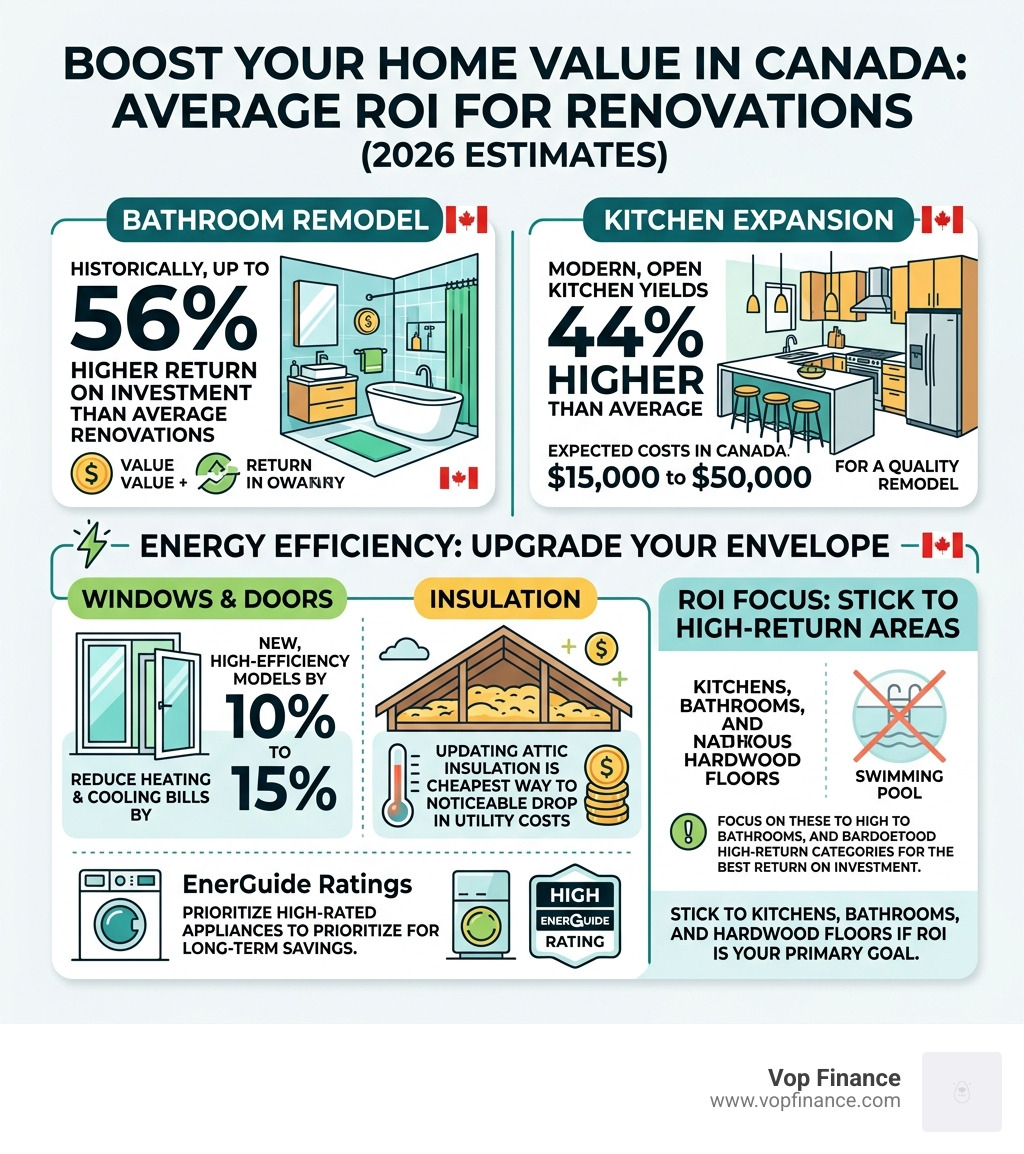
- Bathroom Remodel: Historically, these offer a 56% higher return on investment than average renovations.
- Kitchen Expansion: A modern, open kitchen can yield an ROI 44% higher than average.
- Kitchen Remodel Costs: Expect to spend between $15,000 and $50,000 for a quality remodel in Canada.
While a swimming pool might be great for your summer tan, it rarely adds enough value to cover the cost of financing. Stick to kitchens, bathrooms, and hardwood floors if ROI is your primary goal.
Choosing the Best Way to Finance Home Improvement Projects for Energy Efficiency
In 2026, energy efficiency isn’t just about the environment; it’s about the bottom line. Upgrading your home’s “envelope” can lead to massive long-term savings.
- Windows and Doors: New, high-efficiency models can reduce your heating and cooling bills by 10% to 15%.
- Insulation: Updating attic insulation is one of the cheapest ways to see a noticeable drop in monthly utility costs.
- EnerGuide Ratings: Look for appliances and materials with high EnerGuide ratings to ensure your investment pays off in lower bills for years to come.
4. Government Grants and Energy-Efficient Incentives

Before you sign any loan papers, check if the government wants to give you a hand. Canada has become a world leader in incentivizing “green” home improvements.
The Canada Greener Homes Loan is a standout option. It offers an interest-free loan of up to $40,000, repayable over 10 years. This is specifically for major energy-efficient retrofits like heat pumps, solar panels, and high-performance windows.
Additionally, the CMHC Eco Plus program offers a premium refund of up to 25% to homeowners who use CMHC-insured financing to buy an energy-efficient home or make energy-saving renovations. When you combine these interest-free loans with provincial rebates and Energy Star incentives, the “true cost” of your renovation can drop significantly. It’s often the absolute best way to finance home improvement projects that involve upgrading your home’s infrastructure.
5. Frequently Asked Questions about Renovation Financing
How much equity do I need for a HELOC in Canada?
To qualify for a HELOC, you generally need to have at least 20% equity in your home. This is because the total of all loans secured by your home (your mortgage + the HELOC) cannot exceed 80% of the home’s value. If your home is worth $500,000, your total debt cannot exceed $400,000.
Is it better to use savings or borrow for a remodel in 2026?
It’s a balancing act. If your savings are sitting in a high-interest account earning 4% and a loan costs you 8%, you are better off using cash. However, never drain your emergency fund. We recommend a hybrid approach: use cash for the initial deposit and materials, and use a low-interest financing option like a HELOC for the larger labor costs.
Can I finance a renovation with bad credit?
Yes, but it will be more expensive. If your credit score is below 600, you likely won’t qualify for a HELOC or a prime personal loan. You may need to look at “B-lenders” or specialized home improvement financing companies. These lenders often offer loans from $500 to $40,000 but expect APRs on the higher end of the 7% to 36% spectrum.
6. Conclusion: Building Your Future with Confidence
At Vop Finance, we believe that your home should be your sanctuary, not a source of financial stress. Whether you choose to tap into your home equity through a HELOC, opt for the fast funding of a personal loan, or take advantage of zero-interest government grants, the key is to have a plan.
By understanding the repayment terms, calculating the potential ROI, and considering the tax implications of your debt, you can transform your living space without compromising your financial future. We empower you to make these complex choices effortlessly by providing the insights you need to build with confidence.
Ready to take the next step in your renovation journey? Start your financial journey today and let us help you turn those blueprints into reality.
